
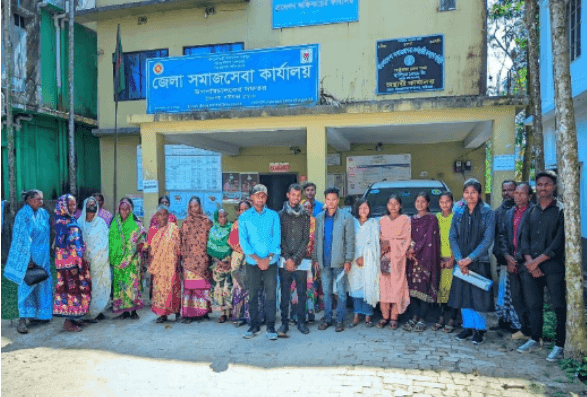
Abalamban actively participated in activities related to both community mobilization and resource mobilization under the SUSHIL Project. Their engagement in advocacy efforts, particularly targeting government service providers such as the Department of Social Services, reflects a strong focus on mobilizing public resources for marginalized groups. Additionally, their outreach efforts on connecting grassroots and indigenous communities with relevant social protection mechanisms are clear examples of community mobilization.
Abalamban received multifaceted support from the SUSHIL Project, which significantly enhanced their technical and institutional capacity, enabling them to effectively advocate for the rights of indigenous communities. As part of this support, they participated in a range of issue-specific advocacy workshops focused on human rights, minority and indigenous rights, land rights, the rights of persons with disabilities (PWDs), and women’s rights. They also took part in various capacity-building training programs aimed at strengthening organizational development and enhancing technical and leadership skills. In addition, Abalamban actively engaged in district-level legal structures, including attending District Legal Aid Committee (DLAC) meetings and participating in research dissemination events on legal and rights-based issues. Their involvement extended to public outreach and awareness-building efforts through roadshows, campaigns on rights and inclusion, and public hearings on community grievances.
Through these interventions, Abalamban was equipped with the knowledge, tools, and networks necessary to successfully mobilize government resources for 33 underprivileged indigenous students in Gobindaganj, Gaibandha
Among the 17 civil society organizations under the Sushil Project in Gaibandha, Abalamban is one of the leading ones. Inspired by the Sushil Project and through advocacy efforts, Abalamban secured one-time grants of 3,000 takas each for a total of 33 underprivileged indigenous students from five villages in Gobindaganj Upazila, Gaibandha District, via the Department of Social Services in Gaibandha.
In the six unions of Gobindaganj, nearly 6,000 indigenous people from the Santal, Orao, Mahali, and Malpahari communities reside. Among them, the Santal community is the largest. Fieldwork revealed that most of these indigenous families live at or below the poverty line. Due to differences in language, dietary habits, and lifestyle, they have limited interaction with the broader community. Many individuals in these communities are too shy or unaccustomed to ask for help, which has led to significant gaps in their access to government benefits. Through Abalamban’s outreach, they were able to establish contact with various government service providers. In this scenario - Abalamban, being a local NGO, with connections to ground realities, were able to provide vital support to the indigenous communities of Gobindaganj through advocacy with local government service providers and community awareness-building. As a partner organization under the SUSHIL Project, Abalamban worked actively to bridge gaps between marginalized indigenous groups and public institutions. In the case of the 33 underprivileged indigenous students mentioned in the story, Abalamban played a key advocacy role by engaging directly with the Department of Social Services in Gaibandha. Their intervention as advocates led to the successful disbursement of one-time educational grants to these students.